Your inventory
is capital. See where it needs attention.
Inventory intelligence for retail chain leaders. Understand where capital is concentrated, how products age and which stores and categories deserve a closer look.
Balances show how much exists. Age helps reveal what needs attention.
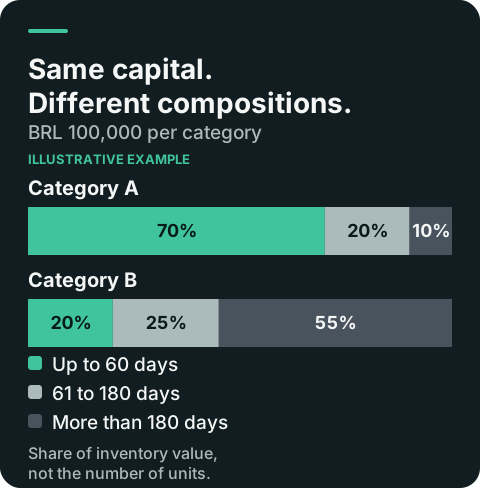
When a discussion focuses only on total inventory value, different situations can look alike. Capital concentrated in recently received products has a different context from the same amount spread across older receipt layers.
Retail leaders need to go further: which categories and locations concentrate the capital? How is that inventory aging? Which products warrant a closer investigation before the next purchasing or assortment decision?
From the retail chain view to the product behind the indicator
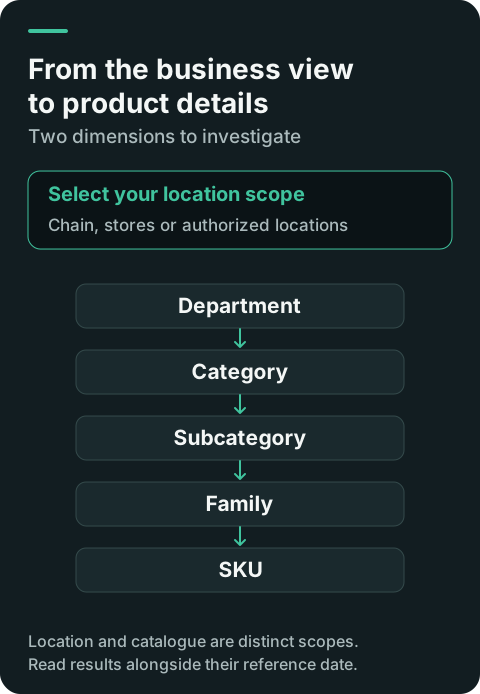
MERO Clear brings together inventory capital and aging indicators to guide that investigation. Explore the catalogue by department, category, subcategory and family, then drill down to the SKU. Location views put each result in the context of the operation.
This path gives teams a shared basis for discussing priorities: the indicator, its reference date and the data behind it. Analysis complements your team’s commercial knowledge; purchasing, promotional and redistribution decisions remain with your operation.
The same inventory value can hide different situations
Imagine two categories with similar inventory values. One mostly contains recent receipts; the other has a larger share of older layers. The financial total alone does not reveal that difference.
This is an illustrative example. With your operational data, combining capital and inventory age helps frame more specific questions, compare relevant scopes and decide where to investigate further. It is not a financial return promise or an automatic action recommendation.
Questions retail chain leaders often ask
Does MERO replace our ERP? The purpose is to provide a layer of product and inventory analysis. Data sources and integration paths depend on the scenario; operational files are not uploaded through this website.
Are the indicators real time? Read them alongside their reference date and the data updates available in the application. A historical inventory position should not be interpreted as a live stock balance.
Can we start with part of the chain? The evaluation scope can be discussed when preparing a POC, considering locations, catalogue and available data. Start with clear questions and a defined scope.
Capital, products and stores.
C
MERO Clear
Available
Inventory intelligence to understand where your capital is concentrated.
O
MERO Orbit
In development
Products in the context of stores and commercial operations.
An evaluation starts with questions and consistent data.
01
Define the scope
Choose the questions, products, locations and reference date for evaluation.
02
Validate the data
Prepare catalogue and balances. Review pre-validation before confirming processing in the app.
03
Investigate indicators
Explore inventory capital and age. Drill down and discuss priorities with your team.
Start with your data.
A proof of concept starts with a clear question and consistent data.
Which inventory question does your leadership team need to answer?
Discuss capital, aging and your operational scope. Explore Clear in a demonstration and assess a path to a POC.