
Adoption starts by defining business questions, preparing catalogue and stock data and validating their consistency. The team then explores indicators in the application and connects the findings to operational context.
1. Define the question and evaluation scope
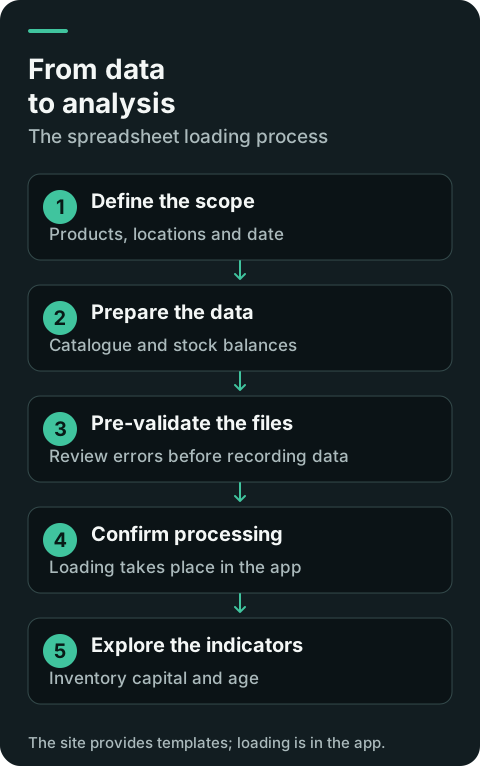
Start with what you need to understand: capital concentration, category aging or differences between locations, for example. Define which products and locations belong to the scope and which reference date will be used.
This helps assess whether the indicators are useful for a concrete business question without treating a sample as the entire operation.
2. Prepare the catalogue, locations and stock balances
The catalogue identifies SKUs and their department, category, subcategory and family hierarchy. Stock balances connect products with locations, receipt dates and unit costs.
Locations must already be registered and codes must be consistent across files. Spreadsheet templates and an API reference support preparation for the chosen integration path.
3. Validate before processing
Spreadsheet loading has two stages. Pre-validation identifies issues without recording the imported operational data; the report includes file, row, column, error code and description. After review, confirmation starts processing.
Invalid data is not silently truncated or corrected. This step reduces ambiguity and lets your team resolve problems at their source.
4. Read indicators in context
After processing, explore the indicators available in the application. Check the reference date, inventory capital and aging information. Drill down to the scope or product that explains a result.
Discuss the findings with the team that knows the operation. Seasonality, commercial policy and assortment characteristics provide essential decision context.
5. Evaluate the next step with your team
The initial evaluation should establish whether the available data and indicators answer the selected questions. Continued use, update frequency and integration arrangements depend on the retail chain’s scenario.
A demonstration is an initial conversation. Submitting the form neither reserves a time nor purchases the product.